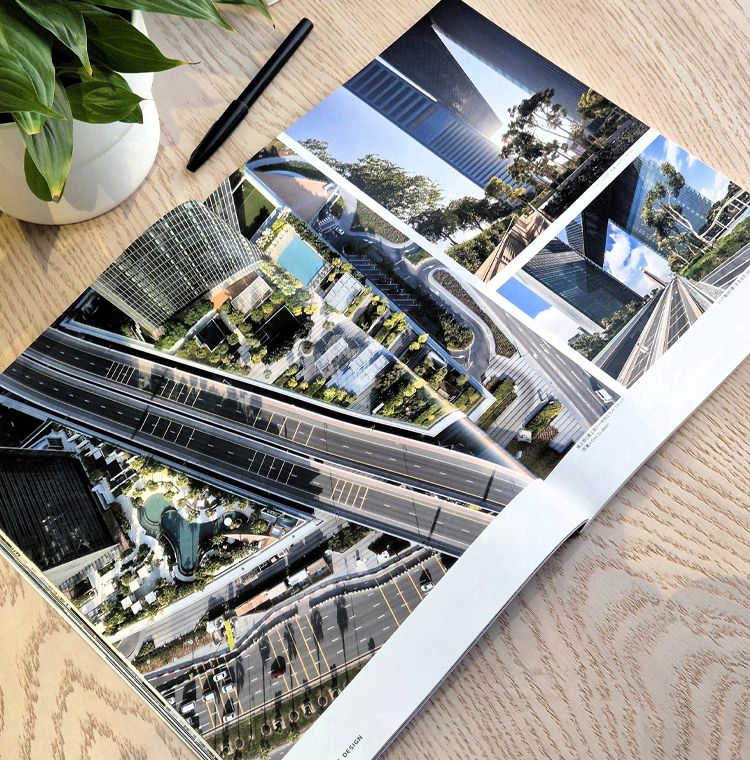

We are proud to announce that our landscape design for One Za’abeel in Dubai has been featured in the August 2025 issue of Landscape Design, Japan’s leading journal dedicated to landscape architecture and urban design. The article presents a comprehensive overview of the 10-year journey behind one of the Middle East’s most ambitious mixed-use developments, and includes an in-depth conversation between Taku Suzuki, Head of Landscape Design at Nikken Sekkei, and Rajan Dewan, Group Design & Technical Director at Cracknell.
Located at a key junction between Dubai’s airport and city centre, One Za’abeel is a visionary urban development comprising luxury residences, hotels, offices, retail spaces, and restaurants, all connected by the 230-meter sky bridge known as THE LINK. The landscape design created a cohesive, high-performance environment across a site divided by a major highway, and within one of the world’s most extreme climates.
The project is a milestone in the Middle East; Japanese firm Nikken Sekkei worked in close collaboration with Dubai-based landscape firm Cracknell, to create a landscape that embraces the concept of the “urban oasis,” offering a calm, richly vegetated environment that contrasts and complements Dubai’s dynamic urban skyline. With native and drought-tolerant planting, shaded pedestrian areas, and elevated rooftop gardens, the design integrates sustainability at every level while enhancing the public realm.
A central theme of the article is the cultural and environmental responsiveness embedded in the design process. The team studied local social behaviours, urban patterns, and cultural practices to better understand the community’s relationship with outdoor space—especially in a climate where shade and water are deeply symbolic and practically essential.
The project also exemplifies how global collaboration can lead to resilient, high-quality outcomes. The dialogue between Nikken Sekkei and Cracknell explores both technical and philosophical aspects of cross-cultural design, from the adaptation of Japanese detail-oriented drawing sets to on-site implementation challenges involving materials, utilities, and microclimatic control. The water features were some of the most challenging aspects involving precise flow control over varying distances and height whilst avoiding unwelcome splash to achieve dramatic and cooling entrance cascades.
Sustainability was a guiding principle from start to finish. The project utilises façade condensate and treated wastewater for irrigation, incorporates LEED-aligned material selections, and prioritises low-maintenance planting strategies suited to Dubai’s arid conditions. These solutions, combined with a strong geometric framework that respond to the site’s unique shape and constraints, contribute to a layered and enduring urban landscape.
This feature in Landscape Design not only marks the successful completion of a decade-long project, but also serves as a case study in how landscape architecture can act as a bridge between cultures, climates, and urban systems. We are honoured to have this work recognised in such a prestigious publication, and hope it inspires future landscape solutions that are as contextually grounded as they are visionary.
📖 Read more in Landscape Design Magazine, Issue 163 (August 2025). Available on the Apple App Store.
Project Team:
Architecture and Landscape Concept: Nikken Sekkei
Landscape Architecture: Cracknell