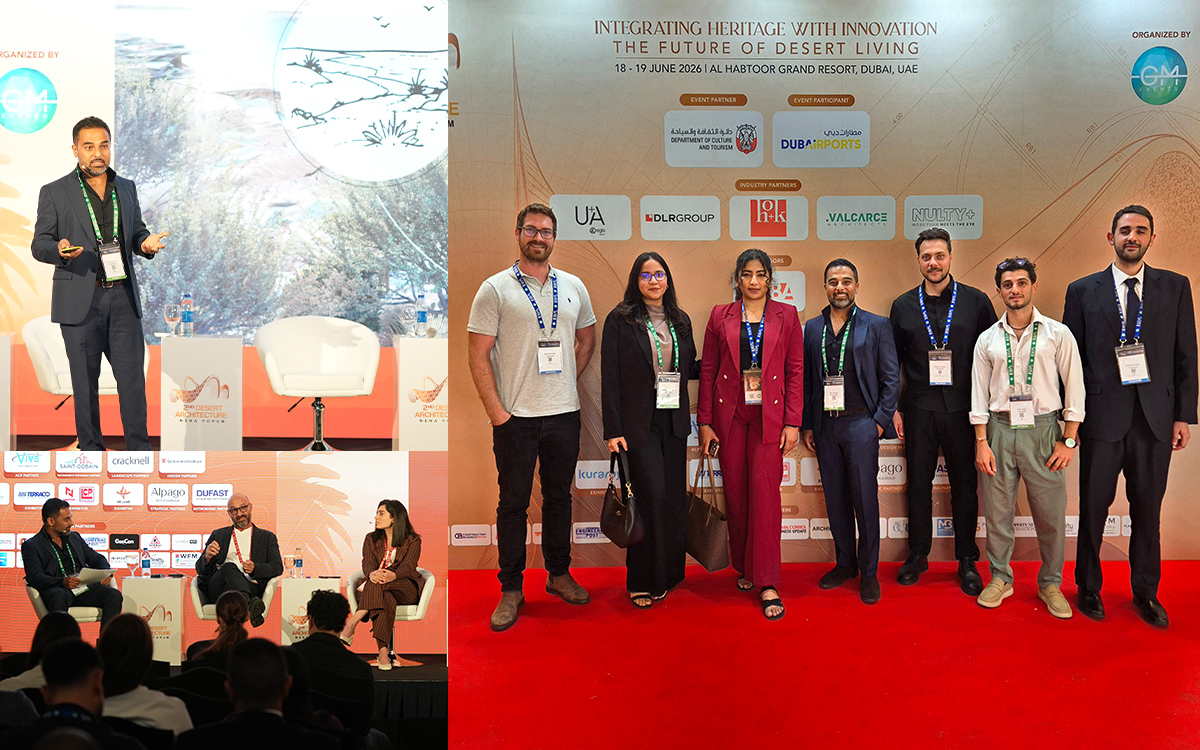

At the Desert Architecture Forum in Dubai last week Design Director Hani Bisada explored Designing Coastal Resorts in Sensitive Ecosystems, looking at the shift in how these resorts are conceived in the MENA region, moving away from imported clichés and towards place-specific, ecologically grounded design.
Hani began by challenging the traditional “eco-resort” model of lush greenery, white sand beaches, and tropical aesthetics which often ignores regional context. In today’s globalised world, travellers are more interested in authentic experiences.
Rather than replicating environments found elsewhere, he stated that designers should celebrate what makes each landscape unique, particularly the distinct character of coastal deserts.
He presented a three-part design philosophy:
- Understand: Study the land deeply—its geography, hydrology, climate, flora and fauna. Identify what makes the place special and how natural systems have shaped it over time.
- Preserve: Protect these defining characteristics rather than altering them. Design interventions should work with the environment, not against it, maintaining the site’s identity while meeting development needs.
- Regenerate: Enhance and amplify key experiences. Through careful framing of views, landscape design, and spatial sequencing, designers can guide visitors to engage more fully with the site’s natural beauty.
Using project examples, Hani demonstrated how challenging coastal conditions can become design assets that retain authenticity while creating memorable user experiences such as elevated viewpoints of the natural landform and use of cantilevered decks for sea-access.
A key to unlocking opportunities is respect for natural processes of hydrology and ecology; existing wadis and drainage patterns should be preserved and integrated into design; controlled saltwater pools can be used instead of artificial beaches to respect wave dynamics and, sensitive environments such as mangroves demand minimal intervention.
Hani went on to emphasise the importance of biodiversity, noting how ecosystems such as mangroves support marine life, regulate microclimates, and contribute to overall environmental health. Design should enable visitors to experience these ecosystems responsibly, through carefully mapped journeys like kayaking routes or elevated paths.
At the same time, user experience remains central. The goal is to share the designer’s understanding and appreciation of the landscape with visitors, guiding them through carefully orchestrated views and moments of landscape appreciation.
Successful projects rely on interdisciplinary collaboration, bringing together planners, engineers, ecologists, and clients through workshops and design charrettes. Hani also highlighted how emerging tools, including AI, are accelerating research and enabling designers to learn from global precedents more efficiently.
Ultimately, Hani’s message is that coastal development in the region should embrace its environment. By respecting natural systems, preserving identity, and crafting lasting visitor experiences, designers can create resorts that are both sustainable, impactful and deeply rooted in place. This approach reflects a broader evolution in landscape architecture, one that values sense of place, resilience, and long-term ecological stewardship alongside aesthetic and commercial success.
Hani went on to moderate a panel on Landscapes of the Future in Desert Design. In parallel with the keynote, the session expanded the conversation beyond hospitality to position landscape architecture as critical infrastructure within desert environments. The panel brought together leading voices from across the region, including Stefan du Toit (DLR Group Middle East), Jide Sleiman Haidar (SOM), Ahmed Tawakol (U+A), Rowan D’Arcy (ASPECT Studios), and Sérgio Ribeiro (Gerber Architekten).
The discussion looked at landscape architecture’s central role in shaping resilient, liveable cities. Key themes included water-sensitive design, the integration of native ecologies, and the importance of embedding environmental intelligence into planning frameworks from the outset. Across the panel, there was a clear emphasis on measurable outcomes, with performance metrics increasingly used to evaluate ecological impact, social value, and long-term sustainability.
Panellists explored the challenges and opportunities of designing in desert contexts, from overcoming barriers to climate-responsive strategies to balancing international benchmarks with a strong sense of regional identity. The conversation also highlighted the value of drawing on historic knowledge, traditional water management systems, vernacular landscapes, and cultural practices, as a foundation for forward-thinking design solutions.
Smart city principles and technological integration were also discussed, particularly in relation to data-driven design and adaptive urban systems. However, despite the focus on innovation and performance, the panel consistently returned to the human experience, ensuring that landscapes foster meaningful connections, enhance wellbeing, and create memorable environments for end users.
The breadth of perspectives and depth of insight made clear that landscape architecture is playing an increasingly pivotal role in the region’s urban evolution.
Cracknell values the opportunity to contribute to these critical conversations and to engage with peers shaping the future of architecture and urbanism in arid environments. With a shared commitment to innovation, collaboration, and context-driven design, the forum once again provided a valuable platform for advancing the region’s ambitions.